Documentation · to follow GitHub · to follow Explorer · to follow Project status
Sovereign Layer-1 chain · QNV

Security you canverify.

Qanovra is an independent blockchain network developed in Germany — built for value intended to last for decades. Every version is independently reviewed, sealed and published with recomputable checksums. Decisions rest on evidence, not on promises.

Corev3.7.5 · audited
Operations layerv0.13.0-rc12
Walletv0.30.17
heritariv2.6
Audit lineage — every state we shipped66 documented states
Qanovra L1 Core
Parallel Ecosystem
Qanovra Wallet
heritari
ComponentVersionCode name heritariv2.6 Cancel Symmetry
If you're new here

The basics, explained clearly

Four questions, four short answers — understandable without any background. The switch at the top right takes you to the technical wording at any time.

What is a blockchain?

A register kept on many computers at the same time. Every new entry is cross-checked by all participants and linked to the previous one. A later change would be noticed immediately, because it would contradict every other copy.

What is Qanovra?

Our own blockchain. Not built on top of someone else's, but written from scratch — and reviewed from the outside, piece by piece, before anything counts as finished.

What is QNV?

The unit this chain counts in. Transferring value means transferring QNV. Think of a balance in your account, without a bank in the middle.

Can I use it yet?

Not yet. The software is finished and reviewed, but the network is not running. Exactly what is still missing is listed openly further down — including the things holding us up.

The value

What Qanovra delivers

Four properties that matter once real assets are involved — for individuals and businesses alike.

No third party controls your balance

There is no office that can freeze your balance or hold back a transfer. You hold the key — and with it the responsibility.

When in doubt, nothing is executed

If a state is unclear the software stops the operation rather than making an assumption. A transfer that is not executed can be repeated — a wrong one cannot.

Built for decades

Holding or passing on value across long periods requires a system that remains verifiable and unchanged after decades. The base layer is designed for that.

Verifiable rather than trust-based

Every published file carries a checksum that can be recomputed locally. Our statements can be checked independently.

The product

The Qanovra wallet

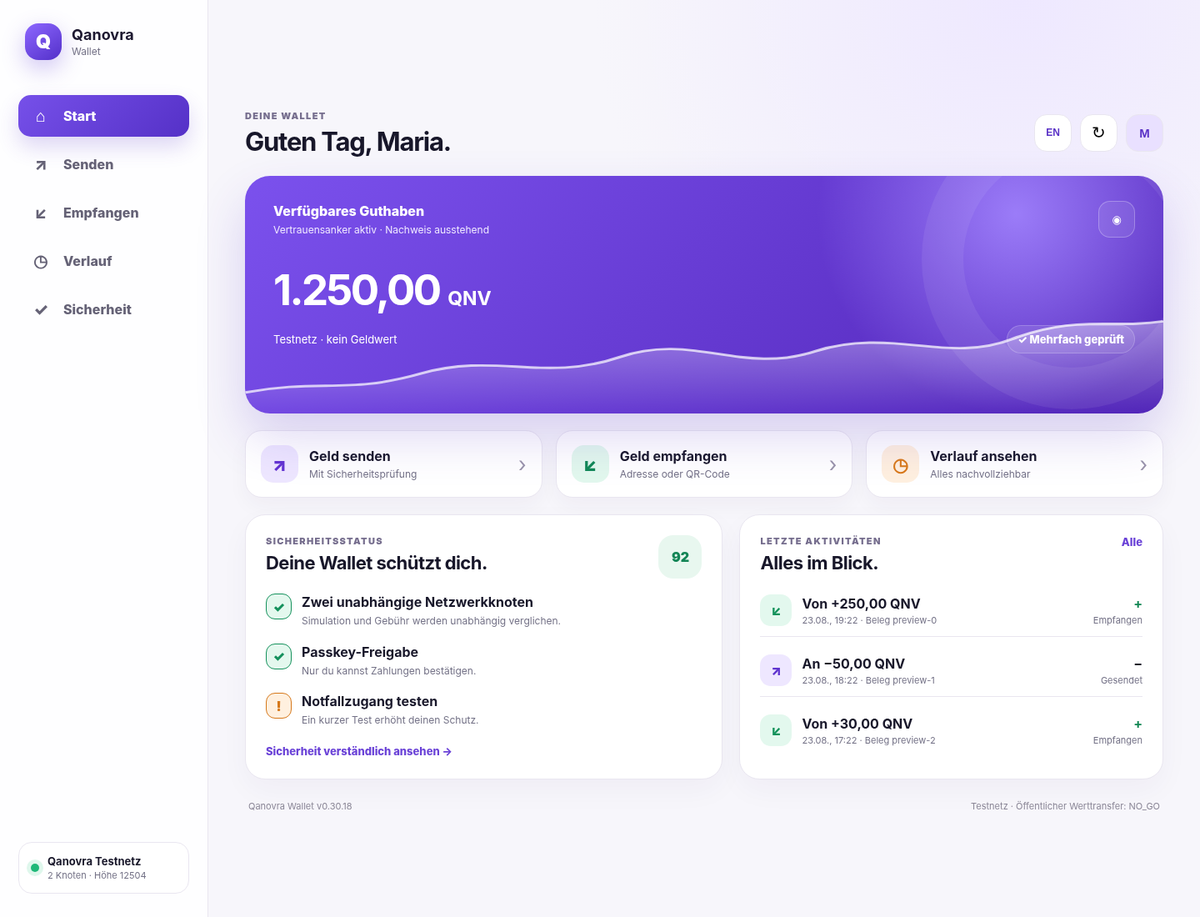
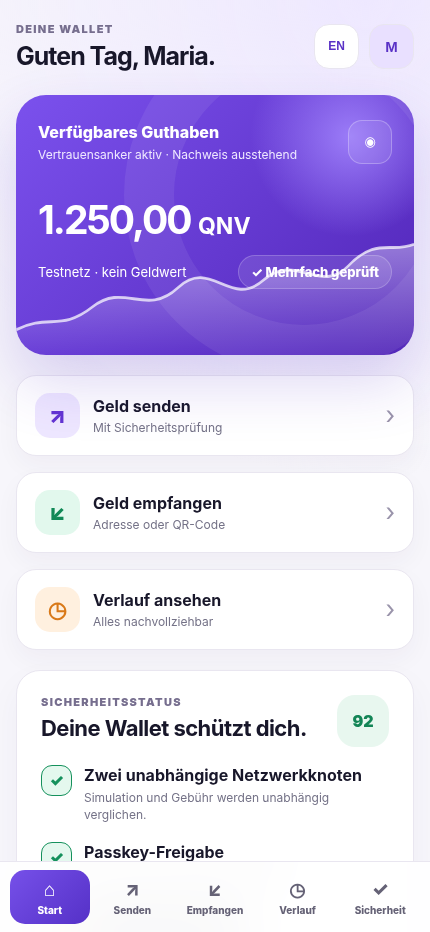
No mockups, no drafts: real captures of the running wallet v0.30.17 from the audit environment. The interface states its status at every step — testnet, no monetary value, public value transfer remains NO_GO.

Qanovra Wallet v0.30.17 · Testnet
Qanovra wallet home view on desktop: balance, security status with checklist and recent activity on testnet
Wallet home view on a phone with balance and quick actions
Home
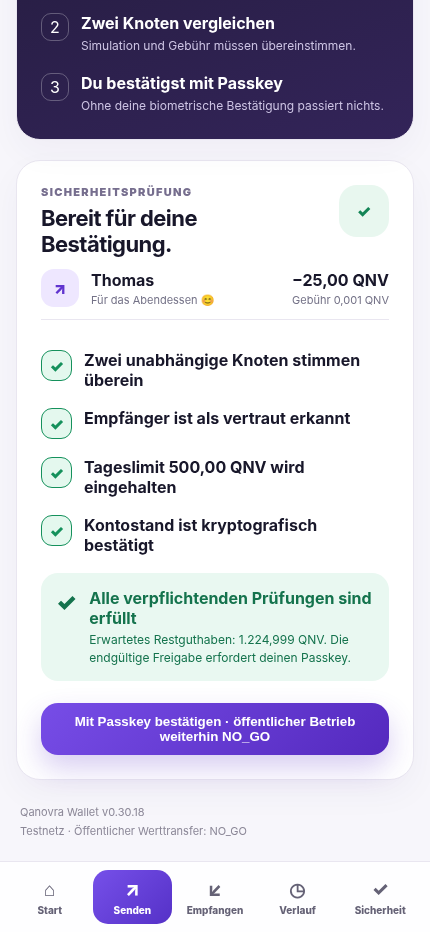
Security check before sending: two independent nodes, trusted recipient, daily limit and cryptographically confirmed balance, then passkey approval
Security check
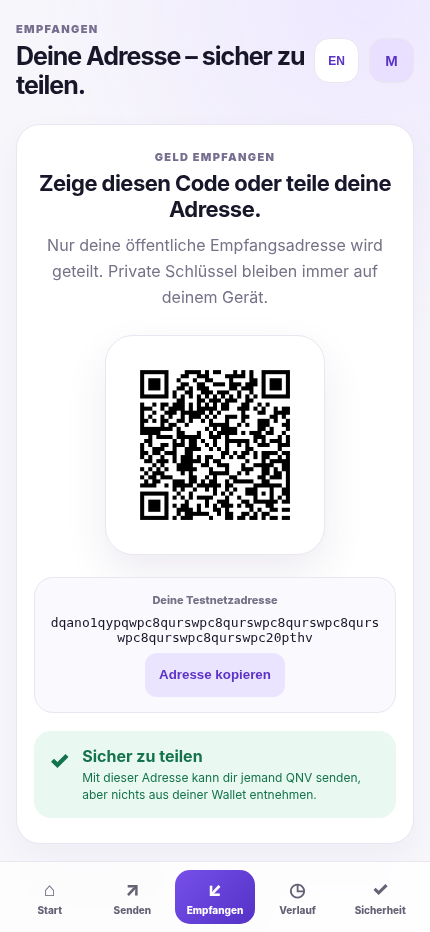
Receive view with QR code and public testnet address; private keys never leave the device
Receive
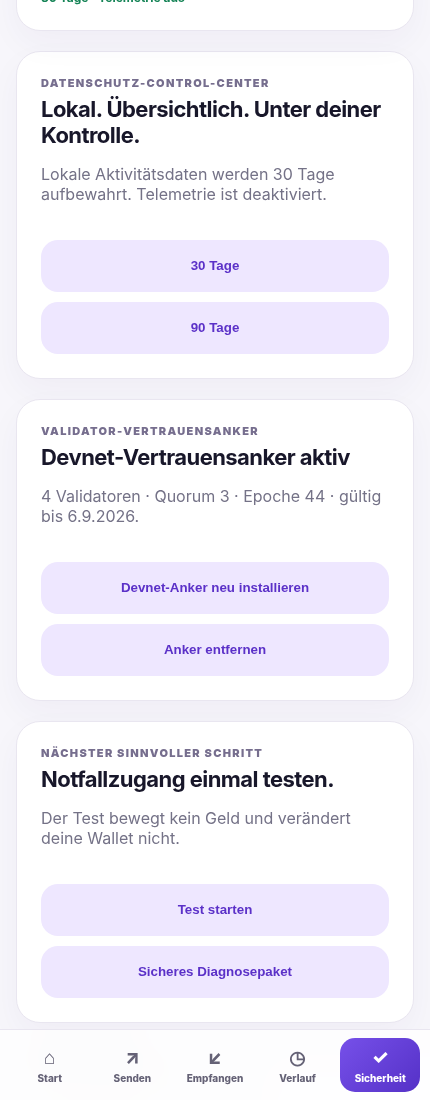
Wallet security section with protections explained in plain language
Security

Captured from the running browser extension in the Chrome-for-Testing audit environment, state v0.30.17 from the frozen audit surface; the image files carry SHA-256 checksums in the source package. Before sending, the wallet confirms four checks — two independent nodes, recipient status, daily limit, cryptographically confirmed balance — and only then releases via passkey. Views of the heritari inheritance product will follow once its rebinding to v3.7.5 is complete.

What the chain is built for

Four rules we hold ourselves to

Always the same result

The same input always gives the same result — on any machine, at any time. Nothing depends on chance.

When in doubt, nothing happens

If something is unclear, nothing happens rather than the wrong thing. In doubt we stop, we don't pay out.

Evidence instead of promises

We claim nothing you cannot recompute yourself. Every version ships with the evidence.

Finished once, then untouched

Every version gets a fingerprint and is never touched again. Whatever builds on it knows exactly what it stands on.

Architecture

Five layers, one root

Each layer is a separately audited state with its own version line. Select one to see the detail.

Decides what happens to digital assets when someone can no longer act — traceably, and without a single person deciding alone.

The app where you see your balance and approve transfers — like online banking, without a bank in between.

A toolbox for developers who want to connect their own software to the chain.

The machinery around the chain that keeps the network running and keeps proving it works correctly.

The foundation: the chain itself. It stores the entries and makes sure everyone sees the same truth.

Token

QNV

QNV is the native unit of account of the network. The full supply of 10 billion QNV exists from the first block — nothing is created or “minted” afterwards. All figures come from whitepaper and yellow paper v2.4.2 for the frozen v3.7.5 baseline.

Maximum supply10,000,000,000 QNVFixed. Rewards may not create units above this supply.
Base unitqnv-atom5 decimals · 1 QNV = 100,000 qnv-atom
Reward curve10% → 6%Target gross: 10% at up to 55% staking participation, decreasing linearly to 6% at 70% and above. Around 8% at the 62.5% reference point. No yield is guaranteed.
FundingFees, then allocationNetwork-security fee revenue first, then an authorised draw from the community allocation. No minting.
TreasuryExactly 4 of 7Threshold authorisation with a timelock; the annual cap is tracked as state.
Staking100 / 100,000 QNVMinimum delegation and minimum self-stake. Self-stake is economic alignment, not consensus voting weight.

Genesis allocation: 51.75% community and network security, 15.00% treasury and ecosystem, 15.00% founder, 8.00% core team, 0.25% ambassador programme, 10.00% remaining canonical allocations. Disclosed openly: the founder allocation is available from genesis by design and is not protocol-locked or vested — the whitepaper states the resulting concentration and liquidity risk explicitly. For core team grants the launch policy provides 48 months with a 12-month cliff and monthly linear release thereafter; this may only be represented as technically enforced once canonical vault evidence exists. Effective reward is funding-bounded and may fall below target. No yield is guaranteed. Slashing applies to a validator's entire bonded stake including delegations — choosing a validator is therefore a security decision, not merely a yield decision.
Founding Validator Program

Five independent operators. Five regions.

Qanovra is assembling its initial independent validator cohort across Europe, North America, South America, Asia and Africa. Five slots, organisationally independent operators, admission on evidence rather than intent.

The admission process is fail-closed: a slot stays open until the operator, the host and the key custody are evidenced. Complete evidence takes precedence over a fast start.

5Slots
5Regions
0 / 5Admitted
Fail-closedAdmission
Independent organisation

No shared ownership, staff or infrastructure with Qanovra or with another cohort operator.

Hardware-backed keys

Validator signing keys in an audited HSM, KMS or Vault. Non-exporting custody, evidenced.

Dedicated host

Documented host with declared region, provider and isolation. Shared consumer hosting does not qualify.

Public operator identity

The operating entity is named publicly. Anonymous operators cannot be part of a founding cohort.

How admission works

Step 1

Intake

You receive the operator package: runbooks, device matrix, build verification and the declaration template.

Step 2

Declaration

You declare entity, region, host, provider and intended key custody. Nothing is assumed on your behalf.

Step 3

Due diligence

Both sides review independence, jurisdiction and operational fit. Either side may stop here without cost.

Step 4

Evidence

HSM, host and operator evidence is produced and bound to SHA-256 checksums.

Step 5

Admission

The gate opens only when the evidence is complete. Incomplete evidence keeps the slot closed.

What you get from us

Operator packageRunbooks, deployment examples and the device matrix, all versioned.
Verifiable buildsReproducible build evidence so you can confirm the binary matches the published source.
Bound evidenceEvery artefact you receive carries a SHA-256 checksum you can recompute.
Direct technical contactYou talk to the people who wrote the protocol, not to a support queue.
Documented economicsStaking, rewards and slashing policy are written down in the whitepaper before you commit anything.
Full transparencyOpen items and outstanding evidence are stated on this page — in the gate status below, not only on request.

No compensation, listing or return is promised here. Staking and slashing policy is documented in the whitepaper; the exact unbonding duration is still to be taken from the frozen configuration.

For developers

Connected in five minutes

Install the SDK, set the endpoint, make the first call. Everything else is in the documentation.

# Qanovra SDK · Python
pip install qanovra-sdk

>>> from qanovra import Client
>>> c = Client("https://rpc.qanovra.example")
>>> c.status().height
148902
Post-quantum

The migration is planned, not performed

Today's signature schemes rest on problems ordinary computers cannot solve. Powerful quantum computers could solve exactly those problems. Anyone holding value for decades has to plan for that before the chain launches — not afterwards.

That is why this section exists. It describes an intention, not a property of the frozen v3.7.5 baseline. Schemes, timetable and review are still outstanding.

Where things standThe frozen v3.7.5 baseline uses SHA-256 for protocol and identity hashing and Ed25519 on the audited signing surfaces.
Hashing still holdsQuantum computers weaken SHA-256 but, on current knowledge, do not break it. Canonicalisation and attestation keep their foundation.
Where the risk sitsThe signature schemes are the exposed part, not the hashes. For assets that sit untouched for a long time, that is the decisive question.
How a switch would runA new scheme would be added under an explicit protocol version and activated deliberately — with new canonical vectors and renewed review.
What is still missingThe choice of schemes, the timetable and independent review. No post-quantum paper exists yet.
Why it is here anywayBecause a digital estate can sit untouched for decades, and the question belongs answered before launch.

No post-quantum security is claimed for v3.7.5 — the baseline is “migration-prepared”. A later move to successor schemes such as ML-DSA or SLH-DSA requires a versioned protocol upgrade, new conformance vectors, orderly rotation of validator and system keys, and an authenticated rebinding path for user accounts.

Attestation

Two numbers everything is checked against

A digital fingerprint was taken of the finished base and published. Anyone can recompute whether the software in front of them is exactly this one — change a single character and the fingerprint no longer matches.

Candidate archive v3.7.5 · SHA-256
1c41b8e5e7f757de2a79937ab5e408021718a456e2eb29f9b1c596a6ccab2414
Genesis hash · network identity
78cefe355c7fb55c53dd173c9ca9d340306054a7fd5718e70d1d3193be7b93a3

The chain ID derives from the genesis hash: “qnv-” plus its first 24 hex characters. A node must not accept a chain ID configured otherwise.

Components

Four building blocks, reviewed just as strictly

Each component is reviewed on its own — with explicitly positive and negative findings, concrete improvements and a remediation package for the next round.

Qanovra L1 Core

v3.7.5 · current audited state

The chain itself — the part that stores the entries and keeps everyone on the same state.

  • scl/ — core package with pytest suite
  • Go and JS canonicalisation clients
  • tools/release_gate.py
  • QNV tokenomics (targeted audit P0-01 / TKN-01)
  • v3.6.9 — sealed reference for heritari
  • Upstream baseline v0.62.0

Parallel Ecosystem

v0.13.0-rc12 — Principle-Based Gate Closure

Everything that keeps operations safe: tools, checks and evidence so the network runs reliably.

  • Deterministic node toolchain
  • Verifier symmetry & audit closure
  • Portable archive profile
  • Environment-independent security gate
  • Qanovra SDK — Python + TypeScript from OpenAPI

Qanovra Wallet

v0.30.17

The app for everyday use: check your balance and approve transfers.

  • Key management and signing
  • QNV balances and transaction history
  • Attachment to the audited core state
  • Audited line since v0.10.9

heritari

v2.6 — Cancel Symmetry

The first finished application: a digital estate solution that passes assets to the right people when the time comes.

  • FastAPI backend with proof-of-life and guardian engine
  • Zero-knowledge vault
  • Bitcoin Taproot vault
  • Solana Anchor program · Ethereum Solidity contract
  • Qanovra inheritance adapter
Application · heritari v2.6

An estate you can prove

heritari makes sure digital assets reach the right people when you no longer can. You check in briefly at regular intervals. If the check-in stops, the trustees you named review the situation and release the handover.

Signing and broadcast stay fail-closed: if a state remains unclear, nothing is paid out. heritari attaches to the sealed v3.6.9 state and deliberately introduces no tradable token of its own.

Bitcoin · TaprootEthereum · SoliditySolana · AnchorQanovra · QNV
Proof-of-lifeRecurring proof of life with defined deadlines and escalation stages.
Guardian engineNamed trustees release the handover — in stages and on the record.
Zero-knowledge vaultDeposited content stays encrypted until the conditions are met.
Bitcoin Taproot vaultTime- and condition-bound spending paths directly on Bitcoin.
Distribution & forfeitureShares, cancellation and beneficiary forfeiture with symmetric abort logic.
Legal packageProduct specification, legal roadmap and law-firm documents ship with the release.
Assurance · in this order

No release without outside eyes

Every state passes the same four steps. Nothing is sealed until all findings are closed.

Step 1

Gate

tools/release_gate.py checks the state automatically. If the gate breaks, there is no package.

Step 2

Independent audit

An external review returns findings with explicitly positive and negative aspects, plus concrete improvements.

Step 3

Remediation

Handoff file, remediation report, tools/remediation_gate.py and the previous audit under external-audits/.

Step 4

Freeze & attestation

Evidence package, SHA256SUMS, self-check and parity_probe. From then on the digest is the reference.

Security

Report a flaw before someone uses it

Security here is a process, not a state. Anyone who finds a weakness should be able to report it — confidentially and without risk.

Responsible disclosureSend reports encrypted to the security address. We confirm receipt and keep reporters informed.
Independent reviewNo state is sealed before an external review has seen it and all findings are closed.
Verify it yourselfAll checksums are published. Every shipped file can be checked locally against SHA256SUMS.
Documentation

The documentation

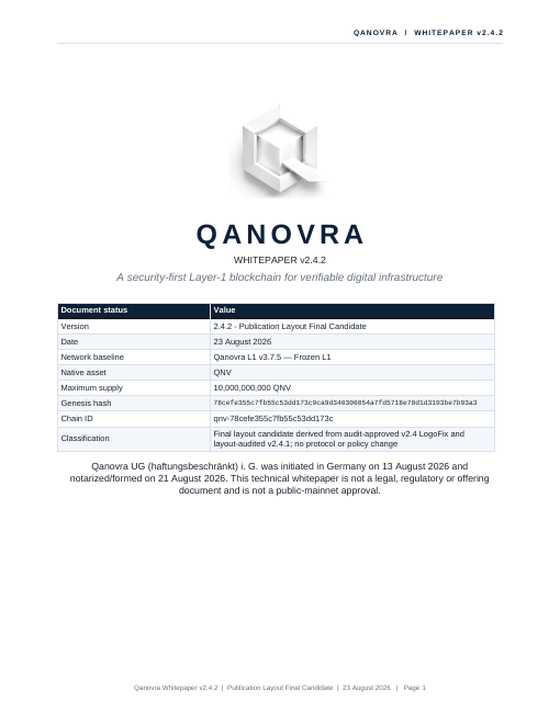
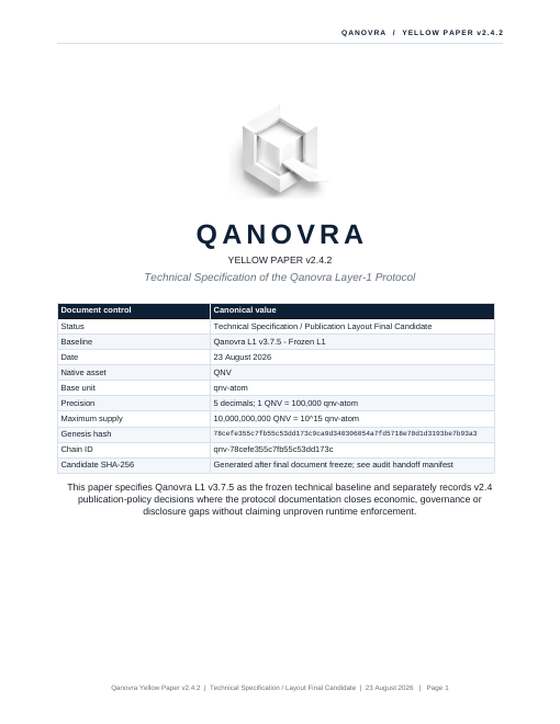
Whitepaper and yellow paper in revision v2.4.2 of 23 August 2026 — the final, frozen publication revision. Every file carries its SHA-256 checksum from the freeze manifest and can be verified locally before reading.

Whitepaper · v2.4.2 · Final freeze · 23 August 2026

Whitepaper v2.4.2

The strategic and institutional description: network identity, ledger and supply integrity, QNV tokenomics with the full genesis allocation and funding horizon, staking and slashing policy, security architecture, governance, readiness and risks.

  • 17 pages
  • 21 sections
  • 9 tables
  • PDF · DOCX
SHA-256 138dc5120ab7552e46db2f5bd74b22f843a1b2c7e1e8012c0d7ceacbf4f4d8d7
Yellow paper · v2.4.2 · Final freeze · 23 August 2026

Yellow paper v2.4.2

The technical specification in 33 sections: state model, transaction and block semantics, consensus quorum, validator reconfiguration, monetary accounting, privileged operations, replay protection, threat model and conformance requirements.

  • 23 pages
  • 33 sections
  • 13 tables
  • PDF · DOCX
SHA-256 81ff22c24d0224c7df5e742addd250745f582b3838fb4ef14b1d4b31d32fa1a3

Further documents

Founding validator briefing v1.0

The operator briefing for the program: requirements, the five-step admission, what operators receive, economics and risk in brief, current gate status and how to apply — two pages.

PDF · EN Open PDF ↓
Freeze receipt v2.4.2

The record of the publication freeze: canonical hashes of all four document files, the lineage of the revision, and the rule that from now on not a single byte changes.

MD · EN Open PDF ↓
SHA256SUMS

Checksums for every published document, so each file can be verified locally.

TXT · — Open PDF ↓
Audit summary

Results of the independent review, once the external security gate is complete.

PDF · EN In preparation
heritari — product specification

How the inheritance solution works. heritari v1.1 remains bound to L1 v3.6.9; a repin review against v3.7.5 is outstanding.

PDF · DE · EN In preparation
heritari — legal roadmap

Legal classification and law-firm documents.

PDF · DE In preparation

Both papers are available as PDF and DOCX — byte-identical to the canonical hashes in the freeze receipt of 23 August 2026. After this freeze not a single byte of the documents changes; any future change receives a new revision with new checksums.

Roadmap

What is done and what follows

No date promises — five phases as set out in white paper v2.1. A phase counts as complete only once its evidence exists.

Complete

Frozen baseline

v3.7.5 stays free of silent drift in consensus, genesis, tokenomics or runtime.

In progress

External evidence

Independent L1 attestation, the real key ceremony, independent validators, a geographic recovery rehearsal and the security and legal gates.

Planned

Invite testnet

Controlled external participation, operational qualification and integration evidence.

Planned

Mainnet decision

Governed go/no-go based on technical and real-world evidence.

Planned

After mainnet

Grow integrations, applications and tooling without bypassing the change discipline.

Gate status

The same board we work from internally. A gate counts as closed only when its evidence exists — a passing test is not a closed real-world gate.

L1 Core v3.7.5

Frozen baseline, candidate archive checksum published.

Closed
Wallet v0.30.17

Frozen line, evidence closure audit.

Closed
Parallel Ecosystem v0.13.0 RC12

Software freeze, no open software remediation item.

Closed
Device matrix

Closed.

Closed
Operational runbooks

Executed and closed.

Closed
4-of-7 key ceremony

Dry run passed with 4 of 7 signatures, observer attestation and negative controls. The production ceremony and genesis seal are still outstanding.

In progress
Reproducible builds

Revalidation required against the current source tree; the earlier cross-platform pass does not carry over automatically.

In progress
Independent validators

Five operator packages prepared, zero operators admitted. Gate blocked on real infrastructure.

In progress
Production signing

Ceremony KMS keys must not be relabelled as production HSM evidence.

Open
Multi-region disaster recovery

Real region loss and measured restore still to be executed.

Open
Red team, DDoS and eclipse testing

Scheduled after real validators are in place.

Open
Independent security audit

Final external sign-off outstanding.

Open
Legal approval

Regulatory review for the intended launch context outstanding.

Open

The readiness matrix in white paper v2.1 records for each area where it stands today and what is missing before broader activation: L1 attestation against the exact candidate, verification that the launch artefact matches the canonical hash and chain ID, wallet and browser qualification in a real environment, production deployment of explorer, RPC and SDK, the real 4-of-7 ceremony with observer evidence, independent validator operators, a genuinely geographic recovery rehearsal, the external security gate and the legal review.

Frequent questions

Answered briefly

Is Qanovra live yet?

No. The current audited state is v3.7.5 and the testnet is in preparation. The roadmap shows where things stand.

Who is behind this?

Qanovra UG (haftungsbeschränkt) i. G., based in Germany: formation initiated on 13 August 2026 and notarised on 21 August 2026. Until registration in the commercial register the project trades explicitly as a company in formation.

Can I buy QNV today?

No. There is no sale and no presale. Anyone offering you QNV is not acting on our behalf.

What happens once all 10 billion QNV are in circulation?

Nothing is “minted” on Qanovra: all 10 billion QNV exist in full from the first block, distributed across the defined genesis allocations. The real long-term question is therefore: what pays staking rewards once the community allocation reserved for them is spent? The whitepaper states this openly: if the 5.175 billion QNV allocation were used solely for the reward curve, it would last roughly 9.4 years at 55% staking participation, roughly 10.4 years at 62.5% and roughly 12.3 years at 70%. After that, rewards are paid exclusively from fee revenue or other already-funded, explicitly authorised sources. Creating new QNV as a fallback is ruled out — if funding declines, the effective reward declines, not the reliability of the total supply.

Why your own chain instead of Ethereum?

Because what an inheritance solution needs — very long horizons, fail-closed behaviour, replaceable cryptography — reaches all the way into the base. You cannot retrofit those properties onto someone else's chain.

Who audits the software?

An independent external review before every release. We summarise the results and publish them under “Papers”.

What exactly does “quantum ready” mean?

That the cryptography is built to be replaced and a migration path exists — not that every scheme has already been switched. The post-quantum paper has the detail.

How can I get involved?

As a developer through the SDK and docs, as an auditor through an audit enquiry, or as an early user through the invite testnet.

Is the specification complete?

Almost. Yellow paper v2.1 fixes the semantic rules and twenty security invariants normatively. Twelve byte-exact details — transaction schema, state-root construction, fee formula, unbonding duration and others — are explicitly marked as “to be copied from the code” rather than invented. Only after that can anyone build a byte-compatible independent client.

Contact

Talk to us

For questions about the technology, an independent review or operating a validator, you can reach us directly by email.